Rubaiyat of Omar Khayyam
About the Book
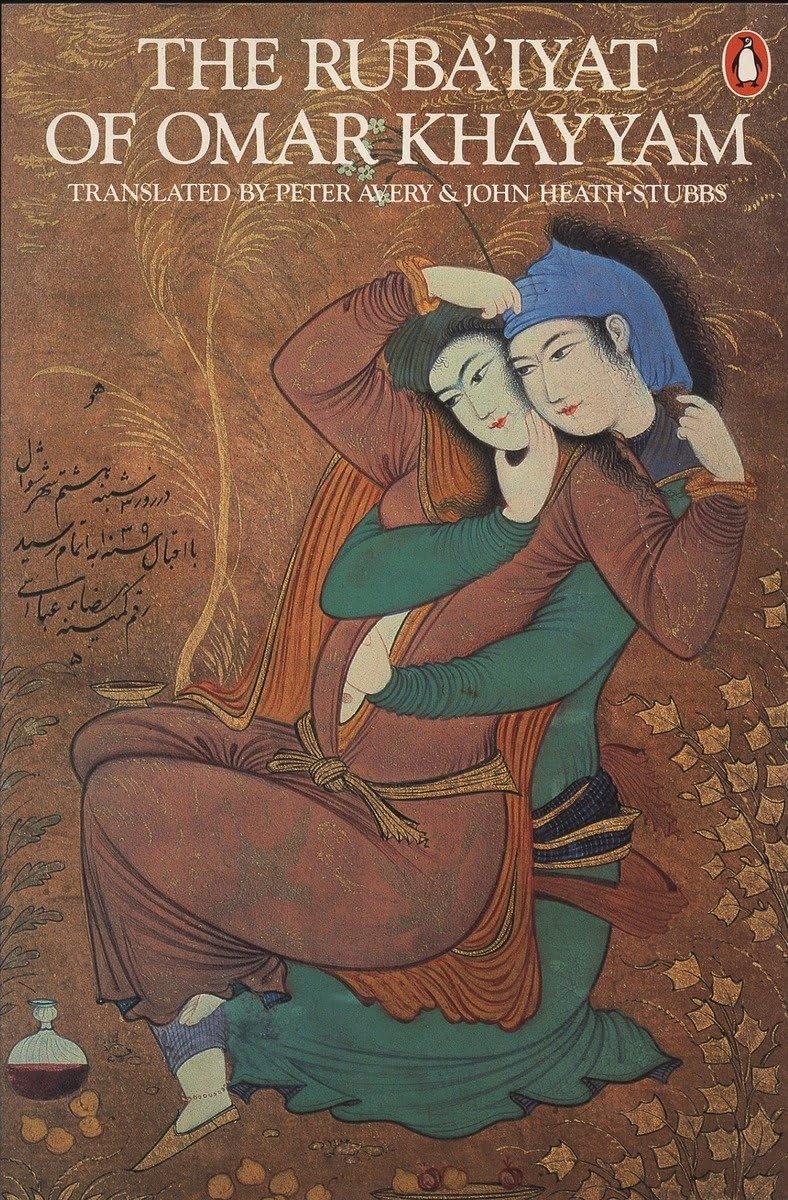
This is a modern version of 235 quatrains from the Rubaiyat of Omar Khayyam, claiming to be “as literal an English version of the Persian originals as readability and intelligibility permit”. This version was translated by Peter Avery and John Heath-Stubbs and published in 1979.
Review
The Rubbaiyat consist of nice little quartrains, mostly extolling the reader to drink wine and enjoy life while it lasts. What is a rubā’ī? It is an epigramatic independent stanza that generally consists of a descriptive or reflective opening, the moral of which is clinched in the last line. Unfortunately, this English translation loses the rhyming schemes of the original (AABA), but the translators have tried to keep the meter and rhythm intact.
Khayyam comes across as a rational person who confronts his chaotic and dangerous environment with the simple message of having fun while we are temporarily on Earth, essentially Epicurean philosophy and hedonism. Many of the rubā’īs talk about the impermanence of our existence, the limits of our knowledge (‘who knows where we have come from; who knows where we are going’), and the difficulties of existence. It is not clear if these are the intended messages, or whether the translators are reading what they want to read. But in the spirit of Khayyam himself and what he would have said 1000 years ago, I write this:
Why are you trying to find meaning in me?
My mind and my thoughts, no one can see;
So, mortal, why split hairs over that and this,
Drink some wine, and live life carefree!
Selected Interesting Ideas in the Book
17
If my coming here were my will, I would not have come,
Also, if my departure were my will, how should I go?
Nothing could be better in this ruined lodging,
Than not to have come, not to be, not to go.
18
What is the gain of our coming and going?
Where is the weft of our life’s warp?
In the circle of the spheres the lives of so many good men
Burn and become dust, but where is the smoke?